


Articles
In 2017, it was estimated that there were about 100 000 home learners in South Africa. This estimate took into account the national census of 2012, the membership of home education organisations, the household survey and the school population. The article on this is available at https://www.sahomeschoolers.org/blog-items/entry/how-many-home-learners-are-there-in-south-africa.html
International trends, particularly from the United States, suggest homeschooling can grow at around 10% annually. While South African conditions differ, anecdotal evidence from local curriculum providers suggests comparable growth. One summary of U.S. homeschooling trends, for example, can be viewed at https://babwell.com/homeschooling/
Based on this growth, it is estimated that home learners grow to about 121 000 in 2019. Such a growth seems realistic, because some curriculum providers reported higher growth than this.
During the pandemic, homeschool organisations such the Pestalozzi Trust and also the HSLDA in the USA experienced a doubling of membership in 2020. If it is assumed that this reflects the growth of home education, it brings the number to 242 000 in 2020. However, as children returned to school in 2021, it was conservatively estimated that home education declined with 10% to 217 800 learners. After this, it was estimated that home education continued to grow at 10% annually again giving 289 891 by 2024.
In December 2023, the Learning Society Institute published a peer reviewed report on home education by Dr Renuka Ramroop from the University of Limpopo. This report provides the first research-based insights into the demographics of home education. This report estimates the number of home learners to be about 300 000, which correlates well with the above estimates.
South Africa has roughly 13 million school-aged learners (based on national education statistics), this would place homeschooling at just over 2% of the total learner population.
This report also gives an estimate of the provincial breakdown, based on the number of responses received.
| Province | Percentage |
| Limpopo | 5,0% |
| Gauteng | 27,5% |
| North West | 6,3% |
| Mpumalangq | 8,2% |
| Western Cape | 24,2% |
| Eastern Cape | 5,2% |
| Free State | 14,2% |
| KZN | 6,7% |
| Northern Cape | 2,7% |
Because these figures are based on voluntary survey participation, provinces with stronger homeschool networks or internet access may be overrepresented. If populations are considered, it seems that Free State is over represented and KZN under represented.
While earlier figures were based on projections and assumptions, they align closely with the first formal research findings — and with the lived experience of homeschooling’s rapid normalization across South African society. More than a decade ago, people would have asked what it is if home education was mentioned. Today, most people will respond by stating that they know a friend or family member that is homeschooling.
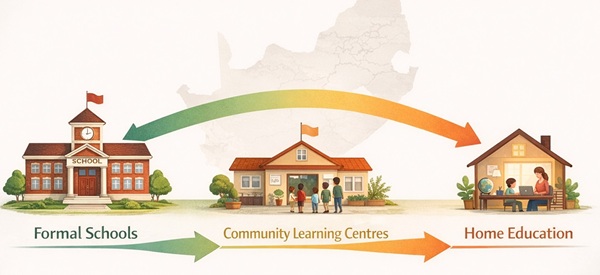
These projections cover learners that receive education at home. There are indications that a growing number of learners also attend so-called learning centres, tutor centres and cottage schools — small, often informal educational initiatives that operate outside the traditional school system.
Both home education and informal centres will increasingly be empowered by online learning platforms becoming more advanced and prevalent. Together, home education and learning centres suggest that education in South Africa is gradually diversifying. Rather than a single dominant model, the future may consist of a spectrum of educational forms — from formal schools on one end, through small community-based centres, to fully home-based education on the other.
Current education law recognises public schools, independent schools and home education, but does not clearly accommodate the growing diversity of hybrid and informal learning models. While the Constitution requires independent educational institutions to register with the state, many emerging education models do not fit neatly into the existing legal categories, creating regulatory uncertainty for home educators and learning centres.
Because the legal framework was designed around traditional schooling models and was only recently amended, significant regulatory reform in the near future may be unlikely. SAHomeschoolers provides regulatory advisory and advocacy services that assists parents and centres to educate children in a safe environment.
Legal & Research
Homeschooling and the law
Home schooling was recognized in 1996 in Section 51 of the SA Schools
+ ViewCentres
Support
Curriculums

Frequently Asked Questions
-
How does homeschooling work?
Homeschooling is different for every family as it depend on the parents educational goals for their children Education is the development of the...
-
Do I need to be a qualified teacher?
No. Research has found no correlation between the qualification of the parent and the academic performance of the child. Research shows that...
-
Will digital ID’s affect homeschoolers?
South Africa is busy introducing digital ID’s. Many parents are concerned that this will infringe on the freedom to choose home education. Creating a...
-
Can I be a working mom and homeschool?
Single parents who are committed to homeschool organize a schedule around their work commitments and sometimes involve family or tutors to assist...